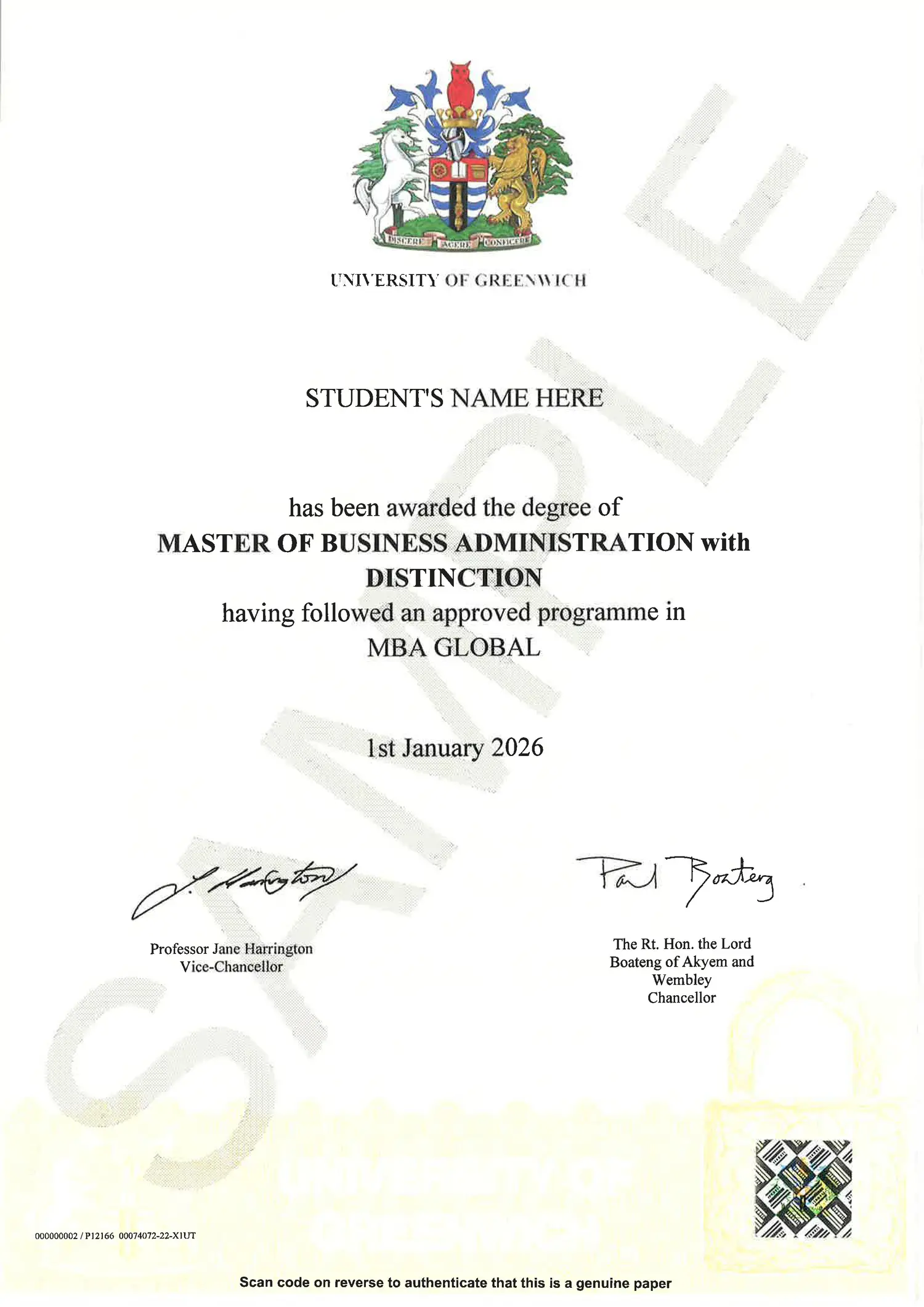
Earn a globally recognised UK MBA in just 12 months!
Designed and awarded by:
This module aims to provide learners with an in-depth understanding of the global business environment, including economic, political, cultural, and regulatory aspects that impact international business operations; the skills to analyse global markets, identify opportunities and threats, and make informed market entry decisions and understanding how to navigate cultural differences, operate effectively in diverse settings.
The aim of this module is to develop students’ entrepreneurial and innovative capabilities; the theoretical knowledge necessary to promote international competitiveness; and the practical skills to drive innovation within whichever context they find themselves.
This module aims to introduce learners to ethical challenges facing businesses and innovators. There is a widespread consensus that business leaders must not merely respect the law but have ethical and social responsibilities beyond the law. Value dilemmas and difficult ethical decisions often end up on executives’ desks, so future leaders must develop reasoning abilities to resolve ethical problems. Learners will engage with a wide range of ethical perspectives and apply them to analyse important ethical case studies. Upon completion, learners will be able to make more confident ethical judgments, to better anticipate ethical and regulatory risks in their business, to resolve ethical conflicts in their team, and to communicate ethical choices more effectively to their stakeholders.
The aims of the module are to offer a wide variety of theories and frameworks applicable to leading and managing change in public service organisations; To identify the special difficulties and complexities associated with leading and managing change in public sector contexts; To examine elements that can facilitate or impede effective change in connection to individuals, organisations, and society in order to challenge long-held preconceptions about change management; To investigate various change agent/change agency models; To present a multi-level perspective on change, emphasising the interconnections between society, institutions, organisations, and individuals.
The aim of this module is to enable students to apply theoretical concepts in the context of a simulated international company that is facing traditional business challenges alongside those posed by the Sustainable Development Goals. The module seeks to foster leadership and team management skills along with intellectual dilemmas and challenges presented by the context of the learning simulation.
The aim of this module is to showcase how funds are sourced for firms and business entities, to teach the ways by which leakage of funds can be stopped, and to demonstrate how to make wise investment decisions. The module will also show how to adequately evaluate cash flow statements and teach how to develop and interpret financial reports/statements.
This course provides students with the opportunity to explore and evaluate the practical application of business concepts through the experience of working as members of a consultancy team investigating a client business issue and construct a detailed consulting proposal to be pitched to the potential client. Competitive consulting proposals will be evaluated by the client and academic staff. The consulting proposal will be evaluated on the basis of likelihood of being the preferred supplier of consulting services to the client. Students will work on live business problems, taking a briefing from the management of client organisations, applying creative problem solving and innovation techniques, presenting a competitive consulting proposal back to the client. The course provides a practical focus of the MBA programme in that students need to integrate all the skills acquired throughout the entire programme. Four aspects will receive special attention in preparatory learning: consulting pitch-design & construction; group-based creative problem-solving techniques; project management concepts, and the soft skill dimensions of being a consultant. This course aims to develop the confidence and competence to apply knowledge to real business scenarios, and to develop the personal and team-based skills to be effective in this. Sector specialisms may be applied to this course.
This module aims to enable managers and aspiring managers to develop a comprehensive knowledge of supply chains. It encompasses core principles and techniques that underpin the successful management of supply chains.
This module presents the strategy, challenges of strategic management, and core components of the environment. The module also discusses leadership styles and theories of leadership traits to meet the current and future needs of the organisation. Therefore, the module’s aim is to enable students to apply effective strategic management aligned with appropriate leadership styles. Consequently, students will be confident to apply a responsible leadership approach in creating value for organisations and their stakeholders.
The concepts of statistics and data analysis tools are introduced in this course within a business and organisational framework. It seeks to give students the analytical tools and skills to effectively summarise and present data supporting decision-making activities. Students will be facilitated and assisted in this work using the proper computing software applications. Through their study of this course, students will be equipped to use statistical and mathematics concepts to address straightforward yet practical problems. The purpose of this subject is to acquaint students with the ideas, vocabulary, methods, and tools of big data analytics.
Applicants who have not studied prior qualifications in English require IELTS 6.0 or equivalent in an accepted English language test.
Recent graduates and early-career professionals
21 years old
SkillsFuture (SSG) and Post-Secondary Education Account (PSEA) funding are currently applicable only to selected programmes offered by public institutions such as NUS, NTU, and SMU. While this programme is not covered under those schemes, we’re pleased to offer exclusive rebates and promotional rates. To learn more about the available fee support and eligibility, please contact our Education Consultants at +65 6580 7700 or get in touch here.
You’ll be equipped for roles such as international business consultant, regional operations manager, trade analyst, or global marketing executive.
Think about your career goals and whether an MBA will help you reach them. Check the entry requirements, including work experience and academic background, and make sure the programme content matches what you want to learn. It’s also worth considering the school’s reputation, networking opportunities, study format and length, as well as the costs and how the degree could impact your future career.
There isn’t a one-size-fits-all answer—it really depends on what you want out of the experience. Some people prioritise a well-known university with strong accreditation, while others focus on flexible learning options like coursework-only assessments.
It’s also worth looking at who will be teaching you and what kind of support you’ll get—things like career services, networking events, and connections with industry can make a huge difference. Don’t forget practical factors too: tuition fees, available funding, and the kind of career paths past graduates have taken.
In short, the best MBA is the one that matches your goals, your lifestyle, and your budget. A good way to find out? Visit open days, talk to alumni, and compare a few programmes before making your choice.
The Master of Business Administration Global offers a comprehensive curriculum designed to develop effective global business leaders. Core modules such as Dynamics of Global Business and Practices, Strategic Management and Leadership, and Global Entrepreneurship and Innovation focus on building strategic thinking and leadership capabilities for international markets.
London School of Business & Finance
PEI Reg. No.: 201008079C, Period: 13 March 2024 - 12 March 2028