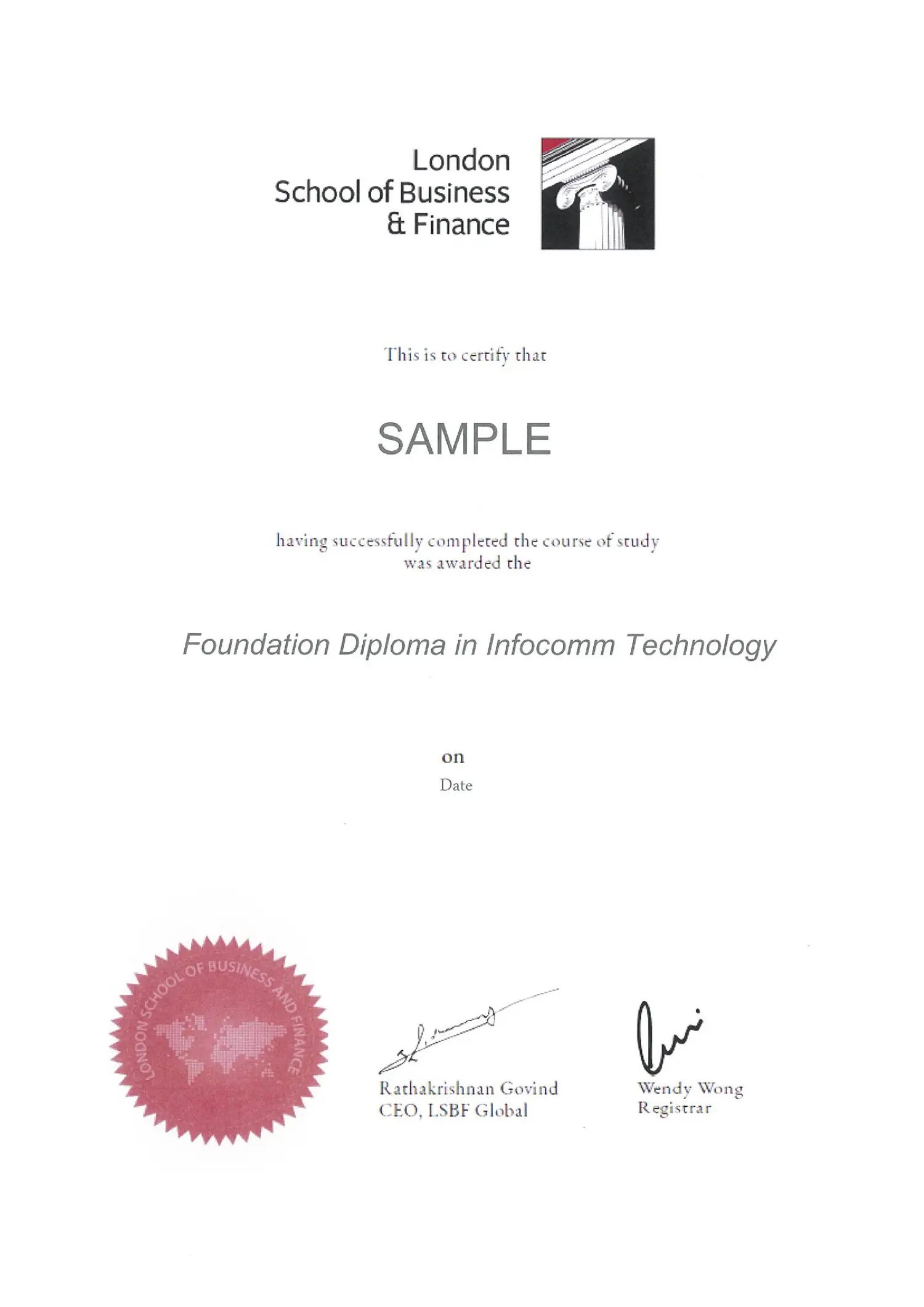
The Diploma in Information Technology (DIT) at LSBF Singapore is designed for individuals looking to build a solid foundation in information technology and gain practical skills for today’s digital economy. As one of the leading IT diploma courses in Singapore, this programme offers a pathway for students aiming to pursue undergraduate degrees in IT courses in Singapore or internationally recognised universities.
This diploma in IT Singapore equips learners with essential technical skills, including analysing and developing applications, coding, testing, debugging, and implementing information technology modules in line with development and security standards. Students also gain experience in refining, integrating, or improving existing applications—a crucial competency in modern information technology roles.
Whether you’re exploring a part time diploma in IT or looking for an intensive full-time course, the LSBF Information Technology course offers flexibility and industry relevance. It’s an ideal choice for anyone ready to launch a rewarding career in the dynamic IT sector.
This module develops the skills and techniques required for creating an overall plan for the design of software, design of functional specifications based on user and business requirements incorporating various controls, functionality, and interoperability of different elements into a designing an information system, modelling which describes the overall architecture in software, databases, hardware, and third-party frameworks that the software will use or interact with. It also covers some of the key legal, social, ethical, and professional issues relating to the information systems development.
This module introduces the basic concept of quantitative approaches to computing mathematics. This module will help students to attain essential knowledge in mathematical concepts and skills that are required for the study and application of computer science.
This module provides students with technical skills, communication skills, to develop applications by coding, testing, debugging, documenting, and reviewing in accordance with object-oriented programming standards for development and security. The module focuses on programming fundamentals such as introduction to computers and object-oriented programming, basic computation, variables, control structures, arrays, and the procedural programming methodology. It then progresses to introduce the object-oriented programming concepts of objects, classes, and inheritance.
This module focuses on fundamental computer architecture, network fundamentals, protocols, and models. This module introduces the categories of the network functions, evaluates, and justifies networks, and device performance using the OSI model and the most widely used TCP/IP protocol suite.
This module provides students with practical skills to examine, translate complex software ideas and concepts into a web application and establish key design principles and methodologies. Students can select and use appropriate tools and techniques with which to design, build, implement, and test a web application. This module also provides the opportunity to gain work skills to be able to provide professional documentation for the web pages produced.
This module provides students with a detailed and essential foundation in cloud computing. Cloud computing is the up and rising technology that will be considered critical in today’s business world. This introductory module to cloud computing describes and explains fundamental aspects of cloud computing concepts, models, technologies, and applications.
This module introduces students to design security architectures and controls; either introducing security principles into the design of architectures to mitigate the risks posed by new technologies and business practices, or the actual design and specification of applicable security components, along with the incidental control measures, to meet defined business security needs.
This module introduces students to the fundamental concepts with hands-on practice of how to administer, configure and update security programmes and mechanisms, including the application of system patches to ensure that enterprise assets are adequately protected against threats. This also includes the authorisation, management, and monitoring of access control permissions and/or rights to various IT facilities.
Local students shall possess one of the following:
Minimum Academic Requirement:
Minimum English Language Requirement:
Minimum Age
18 years old
Students with non-standard entry requirements (e.g. other PEI qualification etc) will be assessed on a case-by-case basis subject to approval of the Academic Board
International Students shall possess one of the following:
Minimum Academic Requirement:
Minimum English Language Requirement:
Minimum Age
18 years old
Students with non-standard entry requirements (e.g. other PEI qualification etc) will be assessed on a case-by-case basis subject to approval of the Academic Board.
Applicable for eligible Singaporean students, Permanent Residents (PR), Employment Pass (EP), Dependent Pass (DP), S Pass (SP), and Work Permit (WP) holders. T&CS apply. Enquire for more information.
NTUC members enjoy 50% unfunded course fee support for up to $500/year with conditions met. For more information, read here.