The lecturers are experienced and very knowledgeable about the subject matters but most importantly they are GIVING and CARING. I believe that the warm and engaging environment created by lecturers and staff for the students had a huge impact not only on my studies but on the development of my social skills. Another thing that I must highlight is the positive impact of student club activities, which facilitated my personal growth and development.
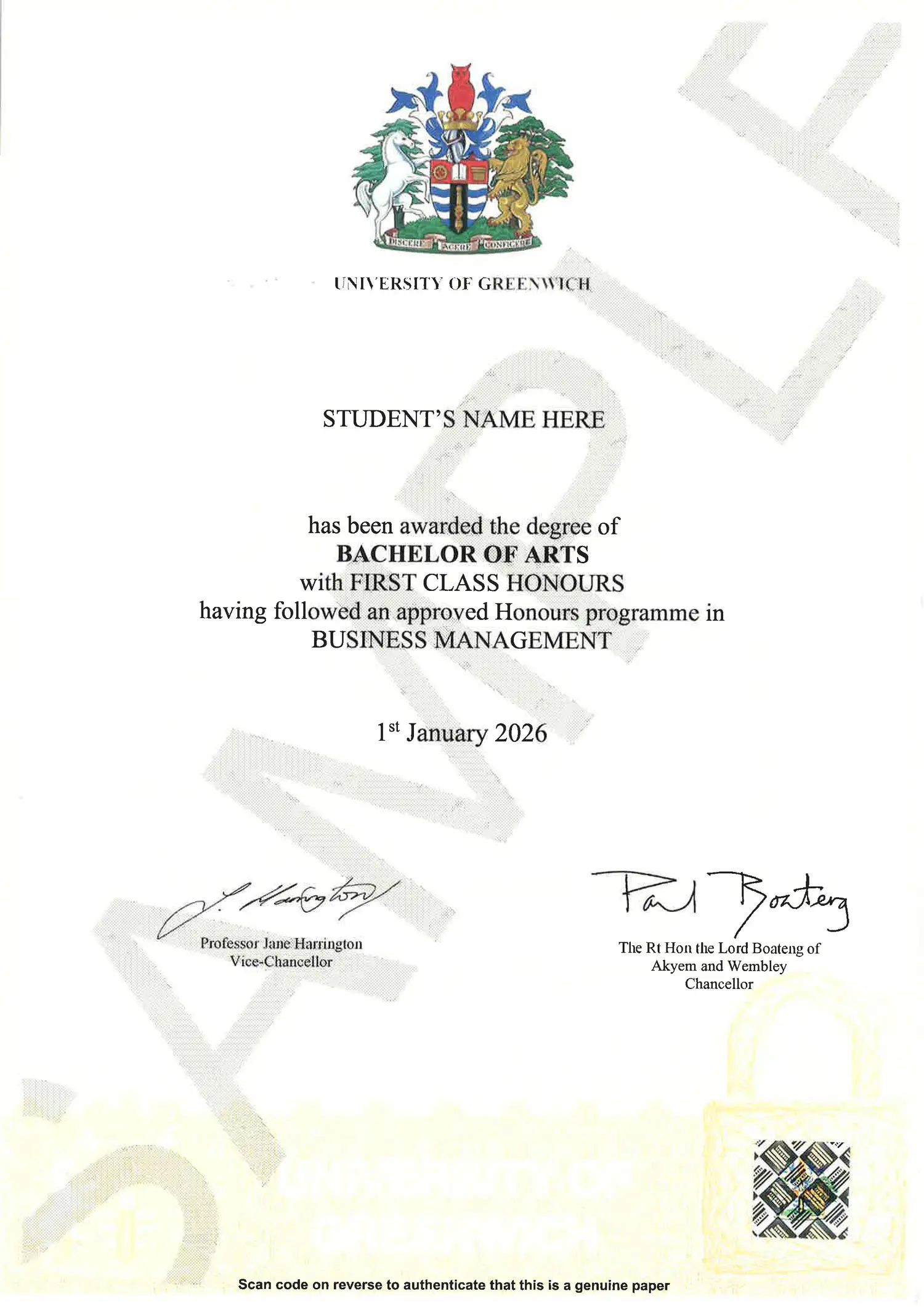
Advance your career with the University of Greenwich’s Bachelor of Art (Honours) Business Management, a globally recognised degree designed for working professionals. Complete your studies in just 2 years—rather than the usual 3—with the flexibility to attend classes during the day, in the evening, or on weekends.
Develop strong commercial awareness and gain an integrated understanding of core business functions, including marketing, finance, and strategy. Alongside technical knowledge, you’ll sharpen your leadership, problem-solving, and decision-making skills to succeed in any industry.
With a curriculum focused on practical application and global business relevance, this programme equips you with the confidence, strategic thinking, and hands-on experience needed to lead teams, manage operations, and make an impact in today’s dynamic business landscape.
This module helps students develop as independent and self-directed learners. It supports students’ transitions into university life by developing their essential academic skills, introducing them to some employability skills, and raising their awareness of their own well-being.
This module is designed to provide a sound and relevant foundation to the study of management as an undergraduate discipline. The module will enable students to explore concepts of management, work and organisation in order to understand their context of use and relevance today. Also, in studying some of the most important themes in contemporary management and organisational practices, students will draw out some of the connections and disconnections between management theory and management practice.
The overall aim is to understand how project management contributes to the achievement of business objectives, both short term and long term. The course provides opportunities to discover the characteristics of projects and project management by applying the method of team-based learning. It also provides a range of academic knowledge and business awareness which enables students to understand the relationship between a project and the parent organisation as well as how to manage it effectively. On completion of the course, students have the core knowledge needed to initiate, propose and select projects with sound business rationales. This course also lays the foundation for developing project management knowledge on level 5 project management planning techniques and skills.
Businesses operate within a complex external environment that impacts organisational operations and decision-making. This module aims to develop an understanding of some of the major external factors that impact organisations; including the political, economic, market, socio-cultural, ecological, demographic, and technological environments. The module examines these influences at various scales: the local, national, and international, and analyses how organisations respond to such external environments, and the challenges and opportunities such environmental contexts present.
This module aims to introduce students to basic concepts related to accounting, banking, and finance as used in modern organisations; build their competence in understanding how these concepts are applied in data, statements, and information communicated to various internal and external stakeholders; and enhance their numeracy skills and confidence in working with financial information in non-finance roles, thereby strengthening their transferable skills and overall employability.
This module will provide students with a range of theoretical and practical knowledge, giving them the opportunity to understand, discuss and evaluate the use of performance management in organisations. It will enable students to develop and apply performance management tools and techniques to specific organisational contexts in which they might operate.
The module will provide an exciting and rewarding journey into the basic principles of Marketing, which will form a cornerstone for the students’ marketing knowledge throughout their degree. Students will be introduced to the ways in which marketing can be used in multicultural societies by companies operating globally as well as those who have a smaller geographic footprint. The module will consider the structure and complexities of markets, competition, and other stakeholders, as well as the importance of environmental and ethical factors in the twenty-first century and how market research can aid organisations in gaining this understanding.
The aim of the module is for students to critically reflect on the responsibility of a (business) organisation, its different stakeholders, and their own potential role in it.
The module is designed to encourage students to understand management practices—including roles, skills, and challenges across various levels and scenarios—apply systems thinking to management contexts, develop the ability to analyse management data critically, and consider the challenges associated with different levels of managerial practice.
The module aims to equip students with analytical tools to evaluate and understand the viability of entrepreneurial ideas, help them identify critical success factors and the capabilities required to build an effective entrepreneurial team, guide them in conducting primary and secondary research to refine their business opportunity and assess its feasibility, and provide an opportunity to critically present their business idea.
The aim of this module is threefold: to equip students with knowledge of research and development (R&D) and innovation trends, theories, and practices; to provide them with key principles, tools, and frameworks for contributing to creative organisations and ecosystems; and to engage them in creative thinking to develop, analyse, and manage ideas for innovation.
The module aims to introduce learners to relevant frameworks to assess organisational effectiveness; to equip learners with a set of analytical tools to carry out an analysis of an organisation; to develop learners’ awareness of the need to consider the perspective of multiple stakeholders when studying an organisation; to introduce learners to basic quantitative metrics to analyse organisations in diverse fields.
The module explores theoretical perspectives and practices for managing equality, diversity and inclusion. It sets out the context within which equality and diversity management have developed from outside and within organisations. It considers the external environmental factors shaping policy and enables students to understand the legal and organisational approaches to equality, diversity and inclusion. The module takes a thematic perspective in considering the key equality and diversity strands (or protected characteristics) from both theoretical and practical perspectives. Students will explore the competing tensions of the different protected characteristics in UK legislation and examine the practices and skills required to manage a diverse workforce. Overall, the module will develop students’ equality and diversity awareness, as well as their analytical and critical thinking skills.
This module will further deepen the student’s understanding of Organisational Behaviour by examining inter and intra group processes within organisations. Students will understand that effective group management is essential to organisational success and that membership of supportive groups can be beneficial to individual well-being. The themes of ethics and well-being will be developed throughout the course.
This module aims to provide students with a solid understanding of the philosophy and practice of business and management research methods. The skills students learn in this course will prepare them for their dissertation, and beyond into employment. This module will achieve this aim by first seeking to develop students’ appreciation of the philosophy of research methods. This foundation will be used to inform students’ understanding of the research-production process: formulating researchable questions, choosing appropriate data collection methods, sample selection, conducting statistical and textual analysis.
This Module is designed to provide students with the knowledge, skills, and analytical capabilities needed to understand, evaluate and practice leadership skills. The module engages a variety of theoretical frameworks to understand, analyse and apply leadership leverage and tools in the context of leading change.
This module will develop participants’ knowledge of the key principles and strategies of negotiation in order to develop their skills for successfully executing negotiations in a broad array of business and organisational situations, including: contract negotiation, procurement, and employee relations. This course will introduce participants to the subject from both conceptual and practical perspectives, drawing on theoretical insights from psychology, sociology, organisational studies, industrial relations, and other social science disciplines.
The module introduces the key concepts, tools and theories of strategy, identifies the role of strategy in organisational performance and discusses the main aspects of change management and strategy implementation. The aims of the module are: 1. To provide students with a deep understanding of strategy and its key components;2. To develop students’ ability to analyse the influence of external and internal factors in strategy formulation and identify he methods of effective strategy implementation; To enable students to identify and critically evaluate the main challenges in strategy implementation process and the ways to address them.
The objectives of this module are three-fold. First, it aims to help students establish a fundamental understanding of the complex nature of decision making in the organisational context with an evidence-based approach to exploring behavioural, organisational, and social factors. Second, this module aims to provide students with a practical opportunity to develop their decision-making skills in both personal and professional context through an enquiry-based approach to solving organisational challenges. Third, this module is intended for encouraging students to cultivate ethical organisational citizenship in the workplace through examining the negative individual and organisational consequences.
This module aims to provide students with analytical tools to evaluate and understand the viability of entrepreneurial ideas; help them identify critical success factors and the capabilities needed to build an effective entrepreneurial team; guide them in conducting primary and secondary research to shape their business opportunity and assess its feasibility; and offer them the opportunity to critically present their business idea before a committee.
The module is designed to give students an understanding of current practical and academic and approaches to small business, enterprise and entrepreneurship. Students will be able to use and apply this knowledge through the development and presentation of a business idea and through the completion of a written business plan.
Minimum Academic Entry Requirements
Local students shall possess one of the following:
International students shall possess one of the following:
Minimum English Language Entry Requirements
Both local and international students MUST fulfil the minimum English language entry requirement of one of the following:
Students with non-standard entry requirements (e.g. other PEI qualification, lack of equivalent Year 12 in home country, etc.) will be assessed on a case-by-case basis subject to approval of UoG.
Minimum Age
18 years and above.
Before applying, it's important to assess your academic qualifications and English proficiency to meet the entry requirements. Consider your career goals and how the curriculum aligns with your interests in areas like marketing, strategy, or entrepreneurship. Think about whether full-time or part-time study suits your schedule, and review the tuition fees and available financial aid. Studying in Singapore offers global exposure, so also factor in lifestyle preferences and living costs. Lastly, explore internship opportunities and industry connections that can enhance your learning and employability.
You’ll be equipped for roles such as marketing executive, business analyst, operations manager, or entrepreneur. This degree opens doors across industries.
You can consider postgraduate studies such University of Greenwich’s MA in International Business, MBA, or a Master’s in Marketing or Finance depending on your interest.
Applicants must meet academic and English language requirements. Local students typically need two GCE A-Level passes, an International Baccalaureate (IB) score of at least 24 points, or a relevant Polytechnic diploma. International students should have completed Year 12 or hold an equivalent qualification. All applicants must demonstrate English proficiency through qualifications such as IELTS 5.5, TOEFL 550, or a pass in LSBF’s Preparatory Course in English. Candidates with non-standard qualifications may also be considered on a case-by-case basis by the University of Greenwich.
*Applicable for eligible Singaporean students, Permanent Residents (PR), Employment Pass (EP), Dependent Pass (DP), S Pass (SP), and Work Permit (WP) holders. T&CS apply. Enquire for more information.
*Up to 12 months* 0% interest instalment plan by DBS or POSB or UOB or HSBC credit cards.