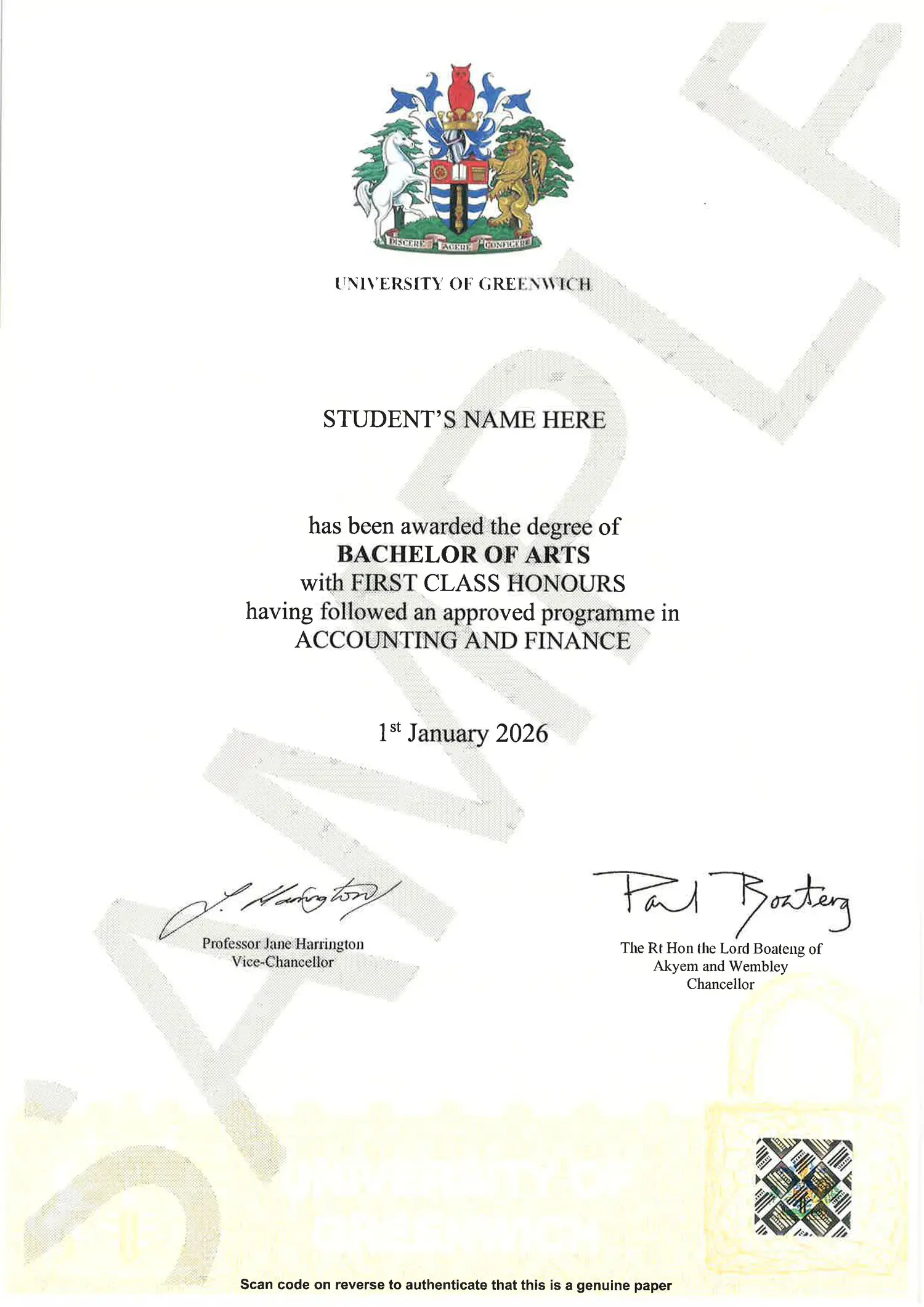
Advance your career with the University of Greenwich’s Bachelor of Arts (Honours) Accounting and Finance, designed for working professionals who want to fast-track their qualification. Complete your degree in just 2 years—compared to the usual 3—with the flexibility to have your classes during the day, in the evening, or on weekends.
Gain an ISCA membership, exemptions for up to 9 ACCA papers, and build a strong foundation in accounting, audit, tax, finance, business law, and more. Alongside technical expertise, you’ll also sharpen your decision-making skills, an essential need for any modern finance role.
With a curriculum focused on industry relevance and professional growth, this programme prepares you to stand out to future employers and thrive in today’s competitive financial landscape.
The aims of the Accounting and Finance (BAAF) degree are:
This module introduces the fundamentals of financial accounting, including its purpose, development, and the qualitative characteristics of financial information. Students will learn double-entry bookkeeping techniques, how to record transactions, extract account balances, and prepare basic financial statements for sole traders and companies. The module also covers the use of elementary accounting ratios to analyse and interpret financial statements.
This module explores the development and role of management accounting within modern organisations. Students will examine historical influences on management theory, the impact of ethics in business, and how behavioural insights shape workplace practices. The module also covers cost classification, the preparation of basic cost accounting reports, and the use of budgeting and standard costing for effective decision-making and organisational planning.
This module supports students in developing key personal and professional skills essential for academic success and future employment. Students will assess their strengths and areas for growth, enhance their ability to work independently and in teams, and deliver effective presentations. The module also focuses on academic writing, proper use of the Harvard referencing system, and reflective practices to support continuous personal and career development.
This module equips students with advanced skills, knowledge, and capabilities to effectively manage, analyse, and critique projects across various business sectors. It focuses on developing the expertise needed to recover failed or stalled projects by critically analysing their causes and identifying appropriate recovery strategies.
This module introduces students to knowledge and understanding of basic statists to summarise and analyse data. Evaluate basic mathematics. Present, evaluate and interpret quantitative data in order to develop lines of argument and make sound judgments in the accordance with basic theories and concepts of the area of Accounting & Finance.
This module provides a foundational understanding of both micro and macroeconomics, along with key principles of finance. Students will explore the role of business organisations and their external environment, the function of central banks and monetary policy, and the structure and regulation of financial markets. The module also introduces short-term financial management and the application of financial mathematics to support effective decision-making.
This module explores the strategic role of management accounting in planning, control, and decision-making. Students will apply various costing, pricing, and budgeting techniques, and evaluate their impact on business decisions. The module also covers theoretical and practical aspects of management accounting, the influence of different costing systems, and how to incorporate risk and uncertainty into financial decisions. Additionally, students will develop research skills through critical literature review and analysis of research methodologies.
This module provides an in-depth understanding of advanced financial accounting practices, focusing on the preparation of consolidated financial statements for groups with subsidiaries and associates. Students will learn to apply International Financial Reporting Standards (IFRS) and understand regulatory frameworks in financial reporting. The module also covers detailed financial ratio analysis, the use of computerised accounting systems, and the application of accounting software such as SAGE 50, with an emphasis on data integrity and system security.
This module introduces students to the key principles of English business law and its relevance within economic, political, and social contexts. It covers the formation and enforcement of contracts, liability in tort, and the legal responsibilities of businesses and their employees. Students will also explore different business structures, corporate governance, and the legal processes involved in forming, managing, and dissolving companies and partnerships.
This module provides students with a comprehensive understanding of taxation principles and their application in various jurisdictions. It covers the computation of tax liabilities for individuals, businesses, and corporations, as well as the legal obligations related to tax declarations and payments. Students will also learn to assess tax planning options and recommend strategies to minimise tax liabilities while ensuring compliance with regulatory requirements.
This module helps students explore and prepare for life after graduation by identifying potential career and educational opportunities. It offers insight into recruitment and selection processes from an employer’s perspective and emphasises the importance of diversity and inclusion in the modern workplace.
This module deepens students’ understanding of advanced financial reporting standards and current accounting practices. Students will learn to interpret complex financial data, prepare advanced financial statements, and effectively communicate accounting information to diverse audiences. The module also develops critical awareness of emerging issues and developments in the field of financial accounting.
This module focuses on the strategic application of management accounting techniques for performance evaluation and decision-making. Students will critically assess the use of financial and non-financial measures across different responsibility centres, such as cost, profit, and investment centres. The module also explores the challenges of identifying relevant information in dynamic environments and provides a comprehensive evaluation of tools available to support managerial decision-making.
This module provides students with a deep understanding of key financial concepts and decision-making processes within organisations. It covers investor behaviour, capital structure, dividend policy, project evaluation, mergers and acquisitions, and the valuation of financial instruments. Students will develop portfolio management skills, apply analytical techniques to enhance shareholder value, and strengthen their problem-solving, numeracy, and communication skills in financial contexts.
This module equips students with the ability to apply and critically evaluate key strategic and financial frameworks used in modern business decision-making. Students will learn to present financial data effectively for professional use, analyse current financial management issues, and assess organisational developments within evolving market contexts.
This module provides a comprehensive understanding of the role and importance of audit and assurance in the context of corporate governance, ethics, and professional standards. Students will explore the audit engagement process, risk assessment, internal control evaluation, and audit planning in line with International Auditing Standards (ISA). The module also develops the ability to exercise professional judgement in applying audit procedures, assessing evidence, and preparing audit reports, while conceptually linking auditing principles with financial reporting and regulatory requirements.
Local and international students entry requirements:
Students who have successfully completed either of the following:
Minimum English Language Entry Requirements:
Local students shall possess one of the following:
Students with non-standard entry requirements (e.g. other PEI qualification, lack of equivalent Year 12 in home country, etc.) will be assessed on a case-by-case basis subject to approval of UoG.
Minimum Age:
18 years and above.
SkillsFuture (SSG) and Post-Secondary Education Account (PSEA) funding are currently applicable only to selected programmes offered by public institutions such as NUS, NTU, and SMU. While this programme is not covered under those schemes, we’re pleased to offer exclusive rebates and promotional rates. To learn more about the available fee support and eligibility, please contact our Education Consultants at +65 6580 7700 or get in touch here.
Graduates are prepared for roles such as accountant, financial analyst, audit associate, or tax consultant. These positions are available in accounting firms, banks, government agencies, and MNCs in Singapore.
An Accounting & Finance degree blends two disciplines, offering a broader foundation than a degree focused solely on finance. It covers both the technical aspects of accounting—like financial reporting, auditing, and taxation—and the strategic side of finance, such as investment analysis, corporate finance, and financial markets. In contrast, a Finance-only degree dives deeper into areas like portfolio management, financial modeling, risk analysis, and global markets, often with less emphasis on accounting standards or regulatory frameworks.
If you're aiming for roles like auditor, tax consultant, or accountant, the combined degree gives you the accounting credentials and financial insight. But if you're targeting careers in investment banking, asset management, or financial strategy, a pure finance degree might offer more specialized tools. Think of Accounting & Finance as a dual lens—ideal for understanding both how money is tracked and how it's grown.
To apply for the BA (Hons) Accounting and Finance at LSBF Singapore, you’ll need a relevant diploma and an IELTS score of 6.0 or equivalent. The 24-month programme, awarded by the University of Greenwich, is taught on-campus with flexible full-time or part-time options. Consider your academic readiness, career goals in finance or accounting, and the financial commitment involved. Intakes are available in January, May, and September.
You may pursue a Master’s of Science in Finance & Investment or Financial Technology, or a professional qualification like ACCA or CA to deepen your expertise.
The BA (Hons) Accounting and Finance programme equips students with essential knowledge in financial reporting, management accounting, taxation, and corporate finance. Upon completion, the BA (Hons) degree will be awarded by the University of Greenwich.